
The 6 Stages of How Illness Develops: The Ayurvedic Map of Why We Get Unwell

One of the most important things to understand is that illness does not come overnight. It is something that accumulates over time — created through habits, circumstances, food, exposure, relationships, lifestyle patterns, and yes, of course, genetics.
The body is constantly sending signals along the way. It is just that we often choose to ignore them, or do not take them seriously enough.
In this article, I want to break down a complex understanding from Ayurveda: how we discern the progression of disease (samprapti), and why it is so essential to begin listening to the small signs if we want to live a healthy and long life.
A lot of people are already familiar with the three doṣas — Vāta, Pitta, and Kapha — and how they relate to different body types, digestion patterns, and ways of thinking.
Each person has a natural propensity toward imbalance based on their constitution (prakṛti).
What many people are not yet familiar with is that each doṣa also has a primary seat in the body:
Kapha in the stomach and upper chest
Pitta in the small intestine (sūkṣma/duodenum region)
Vāta in the large intestine (pakvāśaya)
When, due to lifestyle imbalances, poor habits, or a lack of daily rhythm (dinācaryā — what modern language would call self-care practices), a doṣa begins to accumulate in its own seat, it will start to send clear signals. Nothing alarming at first — at least, that is how it feels.
“Illness does not begin when symptoms appear — it begins much earlier, in a gradual unfolding of imbalance that often goes unnoticed.”
Illness Does Not Begin Suddenly
The body rarely shifts overnight. What changes first are the conditions we live in:
the pace we maintain
the pressure we normalize
the rest we postpone
the emotions we suppress
the signals we override
At first, the body adapts with remarkable intelligence. But adaptation is not the same as balance — it is compensation.
Stage 1: Accumulation (Sañcaya)
When early signals are not noticed, imbalance begins to accumulate in its primary site. You can imagine a bucket slowly filling until it starts to overflow. At this stage, digestion slows, clarity decreases, and the system begins to carry more than it can process.
Common signs include:
bloating or heaviness after meals
fatigue that does not resolve with rest
mental fog
emotional sensitivity
constipation
reduced stress tolerance
Often, the response at this stage is external optimisation — more supplements, more discipline — when what is actually needed is simplification.
Stage 2: Aggravation (Prakopa)
Here, the doṣa begins to become more active, but is still largely contained in its origin. Symptoms are still mild and often dismissed:
lighter or disturbed sleep
increased reliance on stimulants like coffee
irregular appetite
mild irritability
reflux or nausea
a general sense of “not feeling quite right”
At this stage, it is still relatively easy to restore balance through common-sense adjustments and opposite qualities.
For example, a Vāta-type imbalance may present as scattered energy, sleeplessness, irregular eating patterns, coldness, and dryness. Support at this stage would include grounding routines, regular meal times, warm and nourishing foods, and daily oil massage (abhyanga).
Because the system is still responsive, simple consistency can often reverse the trajectory.
Stage 3: Spread (Prasara)
If imbalance continues, it begins to move through the system. It is no longer contained in its original location. This is the stage where symptoms often feel inconsistent or difficult to interpret:
anxiety without clear cause
hormonal fluctuations
inflammation
disrupted cycles or sleep patterns
feeling “not like myself”
dry skin
cold hands and feet
heart palpitations
eczema or skin disturbances
sinus congestion
lymph stagnation
At this stage, Vāta involvement is often dominant, and secondary Vāta-related manifestations may appear in tissues such as the skin, ears, bones, and thighs. Because the imbalance is now mobile and multi-layered, it is usually very difficult to treat effectively without the guidance of a qualified practitioner.
Stage 4: Localization (Sthāna Saṃśraya)
Here, the doṣa settles in a vulnerable area of the body — the weak point of the system. However, this vulnerability is not random. It can be influenced by:
previous trauma
genetic predisposition
chronic emotional stress
suppressed emotions
long-standing lifestyle strain
This weak point is essentially a “fertile ground” where imbalance can take root. The seeds of disease begin to sprout, like weeds growing in disturbed soil. This is why maintaining strong dhātu-agni (tissue metabolism) is essential. When tissue metabolism is strong, imbalance cannot easily settle into the tissues. At this stage, there is still a real opportunity for reversal. With proper support, the doṣas can be guided back toward their original sites, and balance can be restored.
Stage 5:Manifestation (Vyakti)
At this stage, imbalance becomes clearly expressed and diagnosable. For clarity, I am intentionally not listing specific disease examples here — because manifestations are vast, individual, and cannot be reduced to a simple list. What matters here is that the pattern has now fully expressed itself in the body-mind system. What began as subtle imbalance has become structure. And what was once reversible with simple lifestyle change now requires deeper, more sustained therapeutic intervention. But Ayurveda reminds us: this is still a process, not an identity. You are not your illness and your trauma.
Stage 6:Differentiation / Breakdown (Bheda)
This is the most advanced stage of samprāpti, where structural integrity of tissues (dhātus) has been significantly altered. The disease process is deeply embedded, and healing requires long-term, multi-layered therapeutic approaches.
From a modern perspective, this may include chronic degenerative conditions or advanced pathological changes where normal cellular and tissue function has been disrupted.
In Ayurveda, this stage is not approached with fear, but with precise step by step process, sometimes leading to a panchakarma cleanse. The Samprāpti-”Map” shows us the consequences of long-term imbalance, and the importance of earlier intervention.
Why This Matters – Especially in Midlife
In perimenopause and menopause, the body becomes less willing to compensate. Where earlier stages of life allowed for greater flexibility and override, supported by naturally higher levels of resilience and ojas—midlife marks the transition into the Vāta stage of life. As a result, Vāta-related imbalances and conditions may arise more easily than before (interestingly 80% of the illnesses are Vāta related) .
The system becomes less adaptive. What was once manageable causes more discomfort now and can’t be ignored. This is an invitation to listen and take action, giving your health and changing needs more space and attention. It may also mean communicating with your family about what you need and acknowledging that your body has changed through a natural hormonal transition. There is no need to feel ashamed if you no longer run on the same energy you once did. This is not a failure, it is a natural unfolding of aging as a woman. There is something deeply beautiful about listening to your needs and allowing yourself the luxury of greater care, more rest, and a slower pace.
The Ayurvedic Way Back to Balance
Healing in Ayurveda always begins with restoring agni — the digestive and metabolic intelligence of the system. We are not what we eat, but what we are able to digest and assimilate. When agni is strong, dhātu-agni (tissue metabolism) is also supported. Hence this creates resilience in the system, making it harder for imbalance to take root or spread. From there, two foundational principles support long-term balance:
1. Rhythm (Dinacharyā & Chronobiology)
The body thrives on rhythm — not randomness, meaning for the body it is not “cool” to eat whenever you feel like it.
Living in alignment with natural cycles means respecting the doṣa clock:
Vāta time (subtle movement, energetic, connection to heightened states 4–6 AM/PM)
Pitta time (digestion, transformation, yang, solar energy: 10-2 AM/PM)
Kapha time (rest, structure, yin, moon energy: 6–10 AM/PM )
When we live in sync with these rhythms — as well as solar and lunar cycles — the body regains coherence.
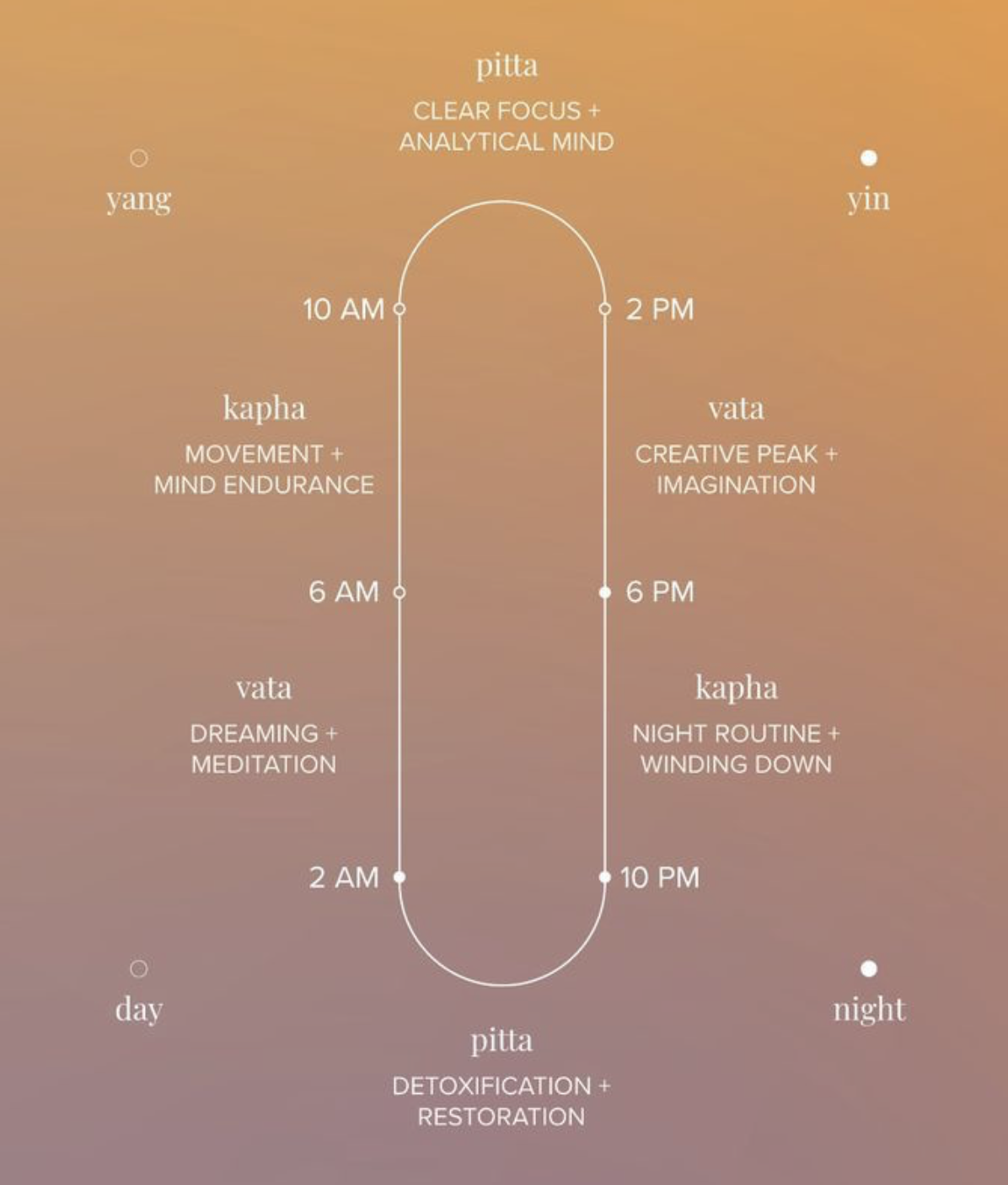
Ayurveda Dosha Clock, photo: Pinterest
2. Simplicity & Consistency
Healing is rarely about doing more. It is about doing less, but consistently. Regular meals. Restful sleep. Focusing simple steps for proper digestion. Grounding routines.
These are not small practices — they are the foundation of resilience.
From Understanding Theory to Embodiment
If this way of understanding the body resonates with you, it is likely because your system already knows something is asking to be realigned.This is exactly where deeper support becomes transformative.
My program COCOON is designed to help regulate the system through Ayurvedic rhythm, especially during perimenopause, using the principles of the doṣa clock and daily alignment.
You prefer 1:1 support? Book an Ayurveda Consultation.
And for women who feel called into a deeper process of rest, reset, and reconnection on the magical island of Mallorca, Wild Grace Retreatoffers a space to step out of the demands of daily life and return to balance in a supported environment.